


Tenants
This betrayal does not mean my promise
did not exist. You take the key, still there
under the stone by the back door. Lost
among the lumber we turn defenceless,
make a search of the room again. A fly’s
flickering against the window testifies
to its dream of elsewhere. In dim light
you kiss me, in this place we have entered
so rashly. The slant sun’s silvering
dismantles our memories. In your breath
in the cold, is a picture of the world.
There’s a feeling of something different
on the other side, where every piece
of the story would fit, where from cut
to cut the stills of the film of our lives
would become like our tears believable.
‘Tenants’ is from Forgetfulness by Ian Seed (Shearsman Books, 2026) — thanks to Shearsman for letting us reproduce it here.
I’ve been fascinated by Ian Seed’s work ever since I reviewed his 2024 collection Night Window. I went on to read Identity Papers and The Underground Cabaret with much delight; there is, as poet and critic Mark Ford has said, something addictive about Seed’s prose poems.
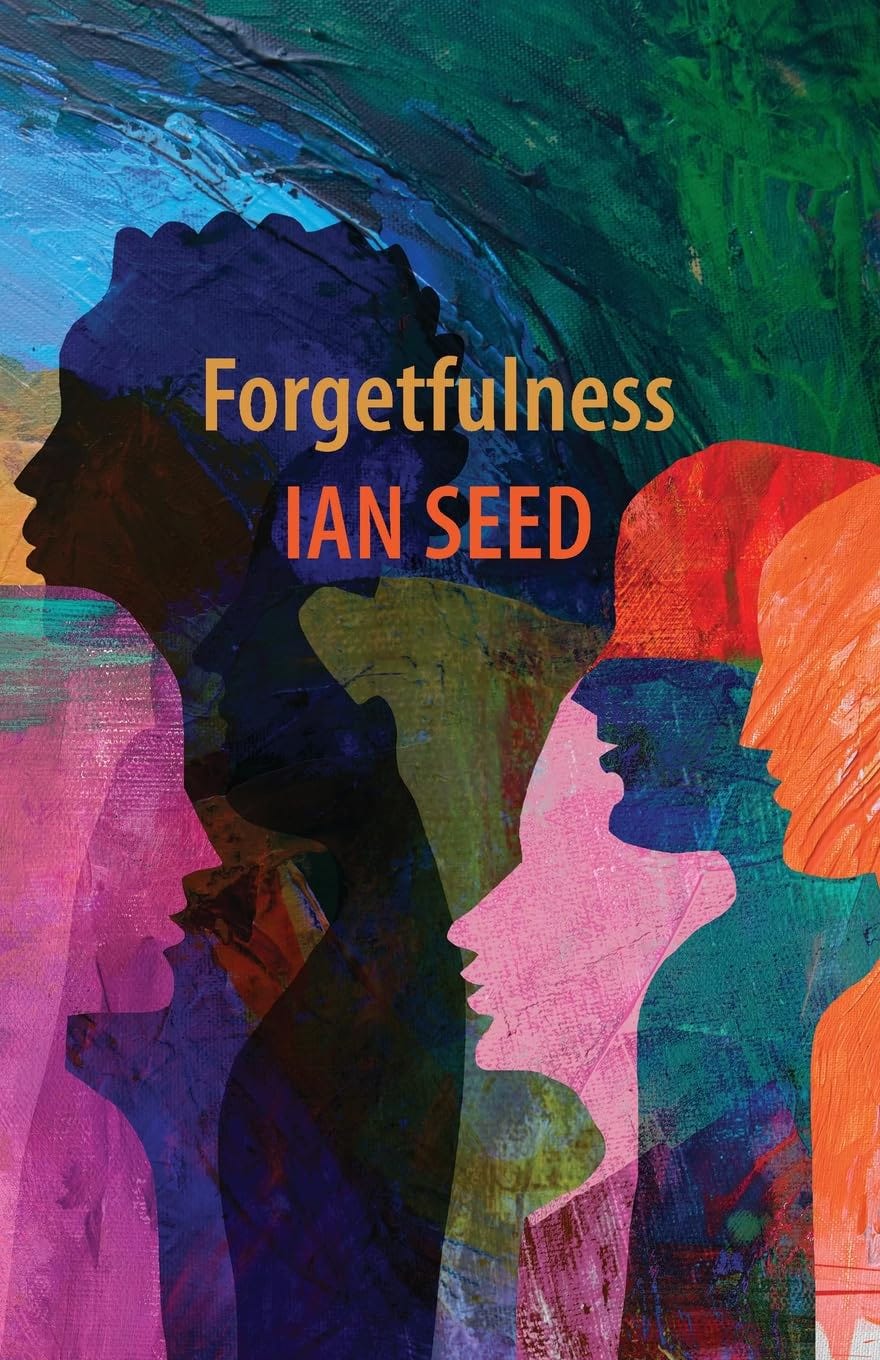
So I felt a little disappointed, at first, to find that Forgetfulness presents quite differently from previous collections. The poignantly comic, absurdist narratives are still in evidence, but they have a distinctly allegorical feel and are broken up by extended departures into other forms. It took time for me to see what Seed might be about here, but I began to suspect that the word ‘dismantles’ (see the introductory poem above) could be key. Because much of the collection concerns the death of Seed’s mother (a friend’s death is also memorialised), he probably needed to dismantle his customary poetic structures to allow for more unshielded self-expression. This very challenge seems to be alluded to in the opening poem, ‘Scattering My Mother’s Ashes’, where, in one dreamlike sequence, the narrator finds himself in Milan:
[…] the wind sweeping down the dark, deserted street where the bus had dropped me off. There was no sign of the poet who’d promised to meet me, but after a while I heard someone softly singing. A young man, who looked like a student I’d once known, emerged from the darkness. I wanted to ask him the way, but when he saw me he drew back, and no words would come to me.
I read this, rightly or wrongly, as Ian Seed coming face to face with his own inarticulateness. Each prose poem in Section 1 seems open to such allegorical interpretation, and the narrator is clearly Seed himself, even if events are fantasy. In one poem, the narrator sees (or imagines seeing) his late mother go by in a coach:
I ran after the coach, waving, and caught up with it at some traffic lights. I put my hands together in a begging gesture and the driver let me on. […] At the next stop, the door at the back opened, and stayed open even when we set off again. The driver must have forgotten to close it. I had to hold my mother tight when we went around a corner.
There is humour in these opening poems, as there can be (and often needs to be) in real life after someone has died. One narrative concerns the copious tea-drinking that marks the days and weeks following a death:
There are just a few of us on the bare, windy hill, standing around in scattered groups. […] I look across the slope at my brother. His cup’s now empty and he’s looking quite forlorn. I feel a drop of something on my cheek, and then another. I’m not the only one. All of us now are looking up at the sky – none of us had any plan for what to do if it rained today. A drop splashes into what must be my fifth cup of tea.
Seed’s skill is to maintain lightness whilst smuggling in the personal and profound. We don’t need to know how much literal truth there is in these tragicomic narratives, but certain lines are clearly heartfelt, as in the last line of this extract from ‘Scattering My Mother’s Ashes’:
Half a year on from my mother’s death, not knowing which way to turn, I rang a Christian helpline. A woman asked me my name, and then in a gentle, yet matter-of-fact tone told me I had ten minutes at most because someone else might be waiting on the line. […] I felt then that within the granted minutes I had infinite time, because love was infinite, and all I had to do was accept it.
It’s difficult to convey properly how these prose poems work without including the whole poem, but hopefully the four extracts above give something of a flavour. I found the whole opening section both readable and moving.
The poignantly comic, absurdist narratives are still in evidence, but they have a distinctly allegorical feel and are broken up by extended departures into other forms
The second section comprises thirteen poems written in conventional stanzas and containing some beautifully lyric moments (“the slant sun’s silvering / dismantles our memories”). Several are fragmented and elusive, some frustratingly so, evoking a sense of disorientation and psychological confusion. Certain words recur – stone, shadow, cold, door, window – and serve to create a sort of visual stage-set. ‘Film’ is referenced more than once, and I found myself seeing images from black and white movies – particularly since cigarette-smoking figures in several poems.
These are poems of loss and lostness; the narrator is like an insecure actor in a production which the rest of the cast insists on performing but for which they see no purpose. The poem, ‘Unscripted’ begins:
A heavy snow. The film eyes
of a stranger. This street is absent
from the story of the city
which I cannot recognise, though
my body’s memory can read
its twists and turns
In a similar vein, the poem, ‘The Jugglers’, opens with:
You walk down stone steps into a crowded square.
No-one turns at your approach. They stand in small groups,
chatting, laughing, waiting for a performance about to take place.
It turns out to be only a set of jugglers who throw their pins
over the nothingness of our lives, maiming the air with their cries.
I see and hear the word ‘miming’ within the unusual use of ‘maiming’ in that last line – as if language itself is being juggled and confused, yet at the same time freighted with double meanings.
Section three of the collection finds us back on the more familiar Seedian territory of absurdist prose poetry (‘Seedian’ must have been coined before but if not, I hereby claim copyright!) These poems are lighter but with a darkish undercurrent; in many, we encounter a persona familiar from Seed’s previous books – an insecure, mildly paranoid figure trying to find their place in a fractured world. The anxiety-dream scenario at beginning of ‘January’ is typical:
My first day back, I couldn’t find my presentation on my laptop. I couldn’t even remember what it was I was supposed to be talking about. My colleagues, my boss and our potential customers watched my fumbling with growing impatience. ‘I’m sorry,’ I said.
The fourth and final section includes three collage-style poems. The longest of these, entitled ‘I Remember’, is inspired by Joe Brainard’s 1970 memoir of the same name. As a university lecturer in creative writing, Seed must have used Brainard’s poem with students many times. It is, put simply, a long string of reminiscences, each beginning ‘I remember’. Brainard’s book consists of 1,500 such sentences; Seed’s poem has 57. The effect of such a poem depends on the clarity and authenticity of each memory and on the haphazard ordering, which mimics how our minds recall the past. Seed’s poem, as with Bairnard’s, pulls us up short with its sudden changes of mood, made more powerful by the matter-of-fact tone:
I remember dancing on my own round the front room with the radio blasting out The Rolling Stones’ new single ‘Get Offa My Cloud.’ My mum yelled at me from the kitchen to turn it down.I remember doing bob-a-job for the Cubs in my green uniform, then spending the money on sweets. I remember my mum’s black eye and my uncle arriving in his van to take us away to live with him and my aunt.[…]I remember my dad barking back at an Alsatian dog behind a steel fence. I remember travelling to Italy with him when I was eight. He was happier on his own.
The whole of this, particularly the last line (which I won't spoil by quoting), must have been hard to write. Using a child’s voice allows Seed to speak directly, without self-indulgence or elaboration.
It’s a strangely disarming collection which needs time to seep in – there’s lots to dwell on concerning the shifting, uncertain nature of memory and of the grieving process
In Forgetfulness Seed has found a singularly inventive and creative way to write about one of life’s most challenging and personal subjects. It’s a strangely disarming collection which needs time to seep in – there’s lots to dwell on concerning the shifting, uncertain nature of memory and of the grieving process. I was reminded of Eliot’s lines in the Four Quartets about writing being a “fight to recover what has been lost / and found and lost again and again”. One can sense Seed struggling, as Eliot did, for a form of articulation, a struggle voiced beautifully in the poem ‘Transfigure’, where he offers this Zen-like thought:
If instead we stay inside the asking,
a fictional window opens, a prospect
emerges which is more than a reworking
of an old map. Each step is the first
on an unmade path towards a horizon
whose mystery remains unreached.
In the unwrinkled pages of the story
the end is uncertain, is forever
in the making, and only possibly true.
Annie Fisher’s background is in primary education, initially as a teacher and later as an English adviser. Now semi-retired she writes poetry for both adults and children and sometimes works as a storyteller in schools. She has had two pamphlets published with HappenStance Press: Infinite in all Perfections (2016) and The Deal(2020), and one recently from Mariscat Press: Missing the Man Next Door(2024). She is a member of Fire River Poets, Taunton.
Vital Statistics: The Friday Poem has 3700-plus subscribers. It’s run by four people – Hilary Menos (Editor), Helena Nelson (Consulting Editor), Bruno Cooke (Spoken Word Editor) and Andy Brodie (Web Editor), with contributions from a team of reviewers and writers.
Until recently we maintained the Friday Poem website (thefridaypoemdotcom) as an archive of 700 posts published between 2021 and 2024 (including most of the original Friday poems) but following a catastrophic hack in late April we made the difficult decision to take this down. We’ll be republishing some of the poems, features and reviews on Substack in the future.
Help support The Friday Poem
Buy us a coffee to help us stay awake as we strive to bring poetic excellence to your inbox every Friday. Heartfelt thanks to everyone who donates, especially to our regular donors. If you can’t afford it, no worries, we’re going to keep on doing it anyway! Big thanks for everything, you lovely poetry peeps.
Thank you so much, Annie, for this generous insightful review.
First I have heard of this poet. Thank you for the in depth review. Time to read more of his work.