


You’ve written a bunch of poems. You’ve done that thing where you print them out on A4 paper, lay them out on the floor, and look at them. (You’ve taken a photo of this for posterity, maybe even posted it on Facebook accompanied by some droll, self-effacing remark.) You‘ve shuffled the order around to see whether certain poems sit well alongside others, to achieve variation in tone, form, and style, and to create some kind of gestalt for the reader. You have considered your theme, or decided that theme is irrelevant (bold choice, but you do you). You have opened and closed with bangers. You’ve chosen a title. You’ve read Roy Marshall’s piece on putting a poetry pamphlet together at least three times. You are ready. In fact you are more than ready. Huzzah! But what if you put this poem here … and move this one there …
Eventually you can’t bear looking at the little bastards any longer and decide to send it out. But where to? How do you know whether your collection of perfect darlings will please the pamphlet publisher of your choice. Poetry is a broad church, but it’s made up of many niches (pardon the mixed metaphor). Which is right for you?
Competitions
One possible pathway is to enter a poetry pamphlet competition. Here’s a list.
The Poetry Business International Book & Pamphlet Competition runs annually. Now in its fourth decade, this is the UK’s most prestigious pamphlet competition and has launched the careers of many poets. Submit 20 poems; the deadline is usually in November. Two winners receive £500 each plus publication and support to extend their pamphlet; two runners up get £100 and publication in The North.
The Poetry Business also runs The New Poets Prize for writers between the ages of 17 and 24. Submit 12 pages of poetry. Two winners get support to extend this to 20 or 24; two runners up get mentoring.
Poetry London Pamphlet Prize
Submit up to 24 pages of poetry. The winner gets £250, publication of their pamphlet with Poetry London Editions, and ten author copies.
Mslexia Women’s Poetry Pamphlet Competition
This competition is for women who haven’t previously had a full collection published. Submit up to 20 poems, over 20-24 pages. The winner gets £500 plus publication by Bloodaxe Books (bloody good deal, this).
Templar IOTA SHOT Pamphlet Awards
Submit 16-25 pages of poetry. Up to four manuscripts are chosen for publication, and each poet is offered the option to submit a further full collection for publication.
Magma Open Poetry Pamphlet Competition
Submit 18-20 pages of poems. The judge will read 50 entries selected by Magma board members. The winning pamphlet will be published and a launch reading hosted by Magma. Poets on the shortlist of ten will each get a paragraph of feedback from the judge.
Alastair Reid Pamphlet Prize
One of the Wigtown Poetry Prizes, the Alastair Reid Pamphlet Prize is supported by The Dark Horse Magazine. The winner gets publication of a pamphlet set by Gerry Cambridge and 30 author copies. Prize-giving happens at the Wigtown Book Festival in the autumn.
The William Bonar Poetry Prize
This is run by Red Squirrel Press in partnership with St Mungo’s Mirrorball. Entrants must be over 18 years old and based in Scotland, and they should not have previously had a pamphlet or collection published. The winner gets publication by Red Squirrel with editorial support from Gerry Cambridge, plus 30 free copies and 50% discount on unlimited further copies. Watch the page on Red Squirrel’s site for info.
Cinnamon Press Pamphlet Award
Submit 15-25 poems of up to 50 lines each. Two winners get a publishing contract plus 30 copies of their pamphlet.
Fool for Poetry International Chapbook Competition
Run by the Munster Literature Society. Submit 16-24 pages of poetry. First prize is €1000, second prize is €500, and both winners get publication and 25 complimentary copies, plus readings at the Cork International Poetry Festival (with three-night hotel stay and full board, hoowah).
Coast to Coast to Coast
Run by Maria Isakova Bennet, Coast to Coast to Coast publishes poetry between unique handmade covers via the Individual Poet Journals Competition. Launched in 2017, more than 1400 hand-stitched journals across seven issues have featured work by almost 100 different poets. They are beautiful. Watch the competitions page for submissions info.
East Midlands Pamphlet Prize
Bad Betty Press has partnered up with Writing East Midlands and Nottingham Poetry Festival to offer publication to anyone living, working, studying or born in the East Midlands, via the Little Betty imprint. Winners are selected by Little Betty editors and the winning pamphlets will be launched at Nottingham Poetry Festival.
Three Pillars Press Poetry Pamphlet Awards
This competition is for poets resident or born on the Island of Ireland who have not previously had a full collection published. Submit ten pages of poetry initially; 30 long-listed poets will be invited to submit their final pamphlet of 20-25 pages. The winner gets €250, the runner up gets €150, both get ten author copies.
Grey Hen Press
Grey Hen is a small independent press which publishes poetry by older women, often themed anthologies but also occasional pamphlets. As they say, “Older women have a lot to say, and they say it with style!” The press ran a poetry pamphlet competition in 2025 – results page here – keep an eye on their site for details of further competitions.
The Brian Dempsey Memorial Pamphlet Competition
Run by Vole Books (previously Dempsey & Windle), this is a biennial competition which last ran in 2025. Top prize includes publication of a 46-page perfect-bound pamphlet and 70 author copies.
Nine Arches Press Primers Scheme
Not exactly a competition but worth a mention here is the Nine Arches Primers scheme – a biannual mentoring and publication scheme now in its eighth edition. Three finalists get mentoring, editorial support and publication. Keep an eye on the Nine Arches submissions page for calls and info. You can buy Primers Volumes six and seven in the shop.
Courage and bonne chance to everyone!
Pamphlet Publishers
Prefer to go directly to a publisher? There are plenty to choose from these days. But how do you work out who best to send to? Some publishers like formal poetry, while some are more oriented towards experimental work, performance poetry or Spoken Word. If your writing is radically different – in style or in layout – from the kind that the press publishes, it is unlikely that you will be accepted for publication. Some publishers prioritise high production values, while others look a bit more hand made. Is it important that your pamphlet has a spine? It sits much better on a shelf that way. Do you want to have input into the cover artwork? Some publishers welcome this; others have a house style or an in-house designer who dictates the look.
Size matters
The Poetry Business pamphlets are A5 (210 x 148 mm) – this is pretty common, as is the standard B format (197 x 130mm). A few pamphlets are larger than A5, and the mini-pamphlets can be as small as A6. How will your work sit on the pages of your preferred publisher? Do you have lots of long poems, or poems with very long lines, or poems that require a certain page format to work? If your chosen publisher uses an A5 format, and some of your poems are 35-40 lines long, a few lines will run onto a second page and look a bit lost. There’s no substitute for buying a pamphlet or two, and laying out your work to suit the format.
A word about editors
Do editors edit these days? Some do, some don’t. One of the best things about being published by a good press is the opportunity to be edited by someone who really knows what they are doing. If an editor is a poet it's worth checking out their poetry to see if you like it or not. You can even contact the poets he or she has published to ask about their experience of working with individual editors or presses.
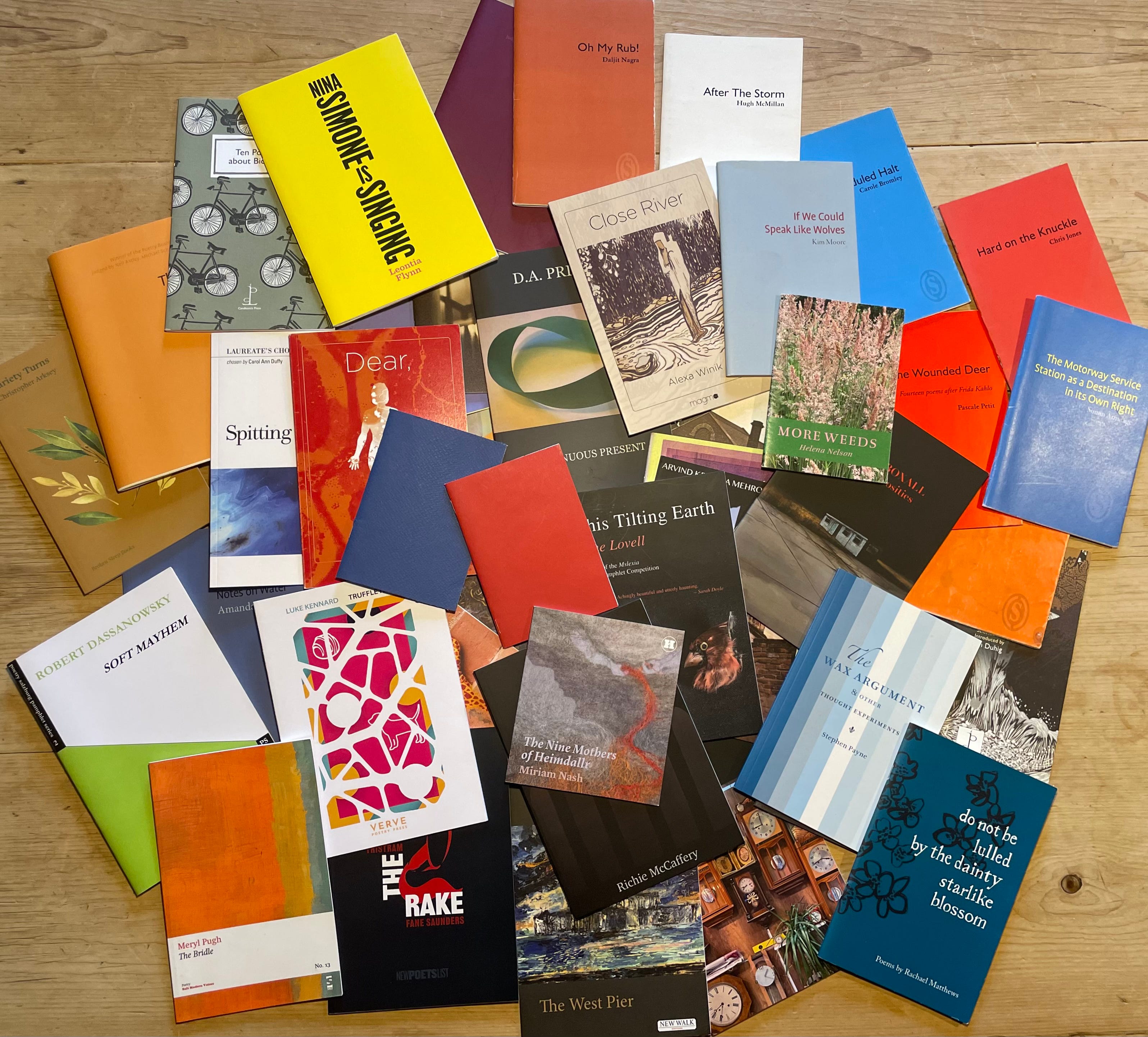
And then there’s the politics. Some publishers select poetry based on literary merit, others seem more interested in the characteristics of the poet. How do you work out which one will be a good fit for you? Our advice: read the text on a publisher’s website carefully before you submit.
Here’s a list. It’s probably not exhaustive, but it includes all publishers who have produced pamphlets recently and regularly and who include pamphlet submissions info on their websites.
Arc Publications
Tony Ward founded Arc in 1969 and now co-runs it, with fellow director Angela Jarman, from a converted textile mill on the Yorkshire-Lancashire border. Other co-editors have included Michael Hulse, David Morley and Jo Shapcott; current International Editor is James Byrne. Arc is a serious outfit, specialising in the work of international poets writing in English and the work of overseas poets in translation. Read Arc’s submissions guidance here and buy their chapbooks here.
Arenig Press
Arenig is based in Mid Wales and promises “bijou independent publishing”. Look at the author page (scroll down) to see who it publishes. Arenig commits to a “proper print run” which is refreshing, if vague – see the list of publications and shop here.
The Artel Press
Artel was established in 2013 and is based in Liverpool. (Artel refers to the Russian collective term for a group of artists.) The press specialises in short-run poetry, artists’ editions and experimental writing, generally from unpublished authors. Submissions info is here, and the shop is here.
Bad Betty Press
Bad Betty was set up in London 2017 by Amy Acre and Jake Wild Hall, and later moved to Nottingham. They publish pamphlets, now under the imprint Little Betty, and also Bad Betty Shots which are limited-edition mini pamphlets. Bad Betty won the Michael Marks Publisher’s Award in 2022. Submissions details are here and you can buy their pamphlets here. Most pamphlet covers are monochrome; it’s a look.
Black Sunflowers Poetry Press
Launched in 2020 by Amanda Holiday, Black Sunflowers is an art-orientated, small poetry press which publishes the work of poets from around the world, with a focus on women and black poets. Read their submissions info here and buy their pamphlets here. Lovely website, great book cover art.
Blue Diode Publishing
Blue Diode is based in Leith, Scotland, and run by Scottish poet Rob A. Mackenzie. It aims to publish “terrific books, especially poetry”, mostly full collections, some pamphlets – buy one here. Keep an eye on Rob’s blog for submissions calls.
Broken Sleep Books
Broken Sleep is “a working-class indie publisher” run by Aaron Kent. “Politically we are left wing, and have no interest in misogynists, racist, sexists, the alt-right, or dickheads in general”. The press gives free PDFs to anybody who asks, and raises money for various charitable causes. Broken Sleep won the Michael Marks Publishers’ Award in 2020. Read their submissions guide here (the next submissions window for poetry pamphlets is October – November 2026) and shop here.
Burning Eye Books
Burning Eye Books, run by Clive Birnie and Jenn / Bridget Hart (they/them), is a small independent publisher in the South West predominately specialising in promoting spoken word artists who are actively gigging. They promise to be ‘Never Knowingly Mainstream’. Read their submissions policy here and buy a pamphlet here.
Cinnamon Press
Run by Jan Fortune-Woods, Cinnamon gets most of its new authors via its pamphlet competition, see above. Read its submissions policy here. It also publishes under the imprint Leaf by Leaf which is described as “an adventure in hybrid publishing” (but sounds a little bit like vanity publishing to us). Buy a book from their shop here (probably this one, by Martin Figura).
Clutag Press
Clutag was founded by Andrew McNeillie and began by issuing hand-printed poetry leaflets in 2000, followed by pamphlets by Geoffrey Hill, Seamus Heaney and Anne Stevenson, among others. The press has a “marked but not exclusive interest in the margins and the marginal, in nature and place, in the British and Irish Archipelago”. See the new series of poetry pamphlets here
Critical Documents
Publishes “contemporary poetry”, says the website, which seems to be rocking a last-century aesthetic. The press publishes a number of pamphlets by J.H. Prynne, and also hosts a list of links to likeminded publishers (many of which don’t work). There are no obvious submissions guidelines.
Crooked Spire Press
Crooked Spire Press is a small, independent publisher based in Chesterfield, Derbyshire, which focuses on poetry pamphlets, collections and anthologies. It is linked to the online webzine The Fig Tree. They hope to open for pamphlet and collection submissions sometime in 2026. Submissions here.
Dare-Gale Press
Dare-Gale is based in Brighton and run by Paul O'Prey and Pilar Garcia. Their author list includes David Harsent, Sean O’Brien and Fran Lock. Lovely website, high production values. Dare-Gale won the Michael Marks Publisher of the Year Award in 2024; the judges said “All the pamphlets we saw from this press were striking and elegant in their design, including some stunning cover images arising from themes in the poetry. The choices of font, setting, and quality of paper are exemplary, and there’s a strong sense of environmental responsibility.” Buy from their bookshop here.
Dithering Chaps
Set up by David and Gena Herring, Dithering Chaps publishes three poetry chapbooks each year, at least one of which will be by a poet who has not previously had a full poetry collection published. You can submit all year round. Read the submissions guidelines here and buy a pamphlet here.
The Emma Press
Set up by Emma Dai’an Wright in 2012, The Emma Press publishes three types of poetry pamphlet; ‘Art Squares’ with full-colour illustrations; pamphlets of 20 poems; and ‘Picks’, which are illustrated in black-and-white. Buy a pamphlet here. There are regular calls for submissions, see here. The Emma Press also publishes lots of children’s books. Covers are often brightly coloured and playful.
Fawn Press
Fawn Press was set up by Scarlett Ward in August 2021. You can get a sense of the sort of work the press publishes from its online magazine, The Thicket. Submission details are here and the shop is here. Lots of pronouns.
Five Leaves Publications
Five Leaves is based in Nottingham, run by Ross Bradshaw, and publishes 10-15 books a year. “Our roots are radical and literary.” Its main areas of interest are social history, politics, poetry, Nottingham, London and cityscape, but it also publishes pamphlets from new and emerging poets, see the new poetry list / shop here.
flipped eye publishing
Founded in 2001 by Nii Ayikwei Parkes, flipped eye has helped develop poets such as Inua Ellams, Malika Booker and Warsan Shire. A significant percentage of its authors are female and/or of Black and minority ethnic heritage. Its ongoing series of pamphlets is published under the ‘flap’ tag. Buy one of their pamphlets here.
Fourteen Poems
fourteen poems is a London-based poetry press publishing LGBTQ+ poets. They put out several pamphlets a year, buy one here, and read their submissions guidelines here (they will want to know how you identify). They claim to be like “Sylvia Plath reading Butt Magazine”. Gosh.
Guillemot Press
Guillemot books look beautiful. The covers are designed by professional illustrators, the books feel lovely, and the paper is gorgeous, often printed on paper made from stuff like the skin waste of cocoa beans, spent beer grain or ocean plastics. It’s based in Cornwall and run by Luke Thompson; you can email him directly. Shop here.
Green Bottle Press
Set up by Jennifer Grigg and based in London, Green Bottle publishes work by poets who have not yet published a pamphlet or full collection. The press works with poets to produce books that suit both the form and the length of their poetry – there’s no standard page size or book length. The submission window for publication in 2027 is the month of June 2026; read the guidelines here. The shop is here.
Hazel Press
Launched in 2020 by Daphne Warburg Astor, Hazel Press focuses on the environment, the climate crisis, feminism and the arts. Astor sought to engage with ecological issues in a “collaborative and provocative way”. Following her death, the press is now run by her friend and collaborator Sara Hudston. Bookshop is here.
Headless Poet
This is a new venture by Jeremy Wikeley – a small press “specialising in the art of the introduction” which hopes to (re)introduce readers to poets of the past, and also to the best new poetry. Wikeley plans to publish five pamphlets per year and send them to subscribers. Subscribe here, and buy their first pamphlet here, Poems Beautiful & Useful, an anthology of popular early modern verse compiled by Victoria Moul.
Hearing Eye
Hearing Eye is a small press established in 1987 by John Rety. It evolved out of Sunday night poetry readings at Torriano Meeting House, and still has its base at Torriano. It has published over 200 books and pamphlets by both new and established poets, from selections of haiku to translations of epic works. See all pamphlets here
Hercules Editions
Hercules Editions was founded by poet Tamar Yoseloff and designer and art editor Vici MacDonald in 2012 with the aim of bringing together new poems with visual imagery. The pamphlets come in a variety of shapes and sizes, but are always stunning, both to hold and to read. The guide to submitting is here (they are very selective) and the shop is here.
If a Leaf Falls Press
If a Leaf Falls is the publishing baby of Faber poet Sam Rivière, with design by O. Tong. It publishes limited-edition titles “with an emphasis on appropriative and procedural writing processes”. Fascinatingly, you can see on the website how many of each pamphlet have been printed – in the low tens for earlier pamphlets; more recently print runs have hit 100. Open submissions policy. The shop is here.
ignition press
Established in 2017 by Niall Munro, Les Robinson, Clare Cox and Alan Buckley, ignition press is based at Oxford Brookes University. Isabelle Baafi is currently guest editor. The press has produced thirty pamphlets so far – buy one here. It won the Michael Marks Publishers’ Award in 2021; the judges said: “Whether it’s down to the iconic design which lends a seriousness to the pamphlet as a form, or the high level of dedication to developing and mentoring the emerging poets it publishes, the result is a press that publishes tight, well-worked and vital early collections that sit together as well as they stand apart”. Submissions details are here.
Indigo Dreams Publishing
Ronnie Goodyer and Dawn Bauling formed Indigo Dreams in 2009. The press is based in Cookworthy, Devon. Both have been around the world of poetry for a while; Ronnie also ran his own celebrity management company handling projects for Uri Geller, Ian Botham and Mike Read. Buy pamphlets here, and read submissions guidelines here.
Knives Forks and Spoons Press
KFS is an independent publishing house based on Merseyside. It was established by Alec Newman in April 2010. The press publishes avant-garde and experimental poetry, some of which is in pamphlet form, by new and established poets and artists. Submissions info is here, shop is here.
The Lifeboat Press
Lifeboat was established in 2012 in Belfast and is edited and run by Stephen Connolly and Manuela Moser, both graduates from the Heaney Centre. Authors include Paul Muldoon, Leontia Flynn and (one of our favourites) Dane Holt. Lifeboat readings have become a fixture of the Belfast poetry scene. Submissions info is here, shop is here.
Longbarrow Press
Longbarrow is a Sheffield-based independent poetry publisher with a reputation for work that explores the intersections of landscape, history and memory. It was established in 2006 and is run by Brian Lewis; he doesn’t accept unsolicited submissions, but there is an email if you want to make a pitch. The online shop is here. The Longbarrow Press blog is really worth a read.
Mariscat
Mariscat, run by Hamish Whyte, is now one of the longest-running self-funded small presses in Scotland, and is a two-time winner of the Michael Marks Publishers’ Award, in 2023 and 2015. In 2023 the judges said: “We were impressed by the consistently high standard of the poetry, and the individuality that shone through the presentation of each pamphlet even while it retained a Mariscat ‘feel’ (partly literally, as Mariscat pamphlets are very tactile objects).” Mariscat is also known for its quality backlist which includes work by Douglas Dunn, Jackie Kay and Michael Longley, as well as Edwin Morgan, Whyte’s friend for over 30 years. Submissions details are here, and the shop is here.
Mica Press
Mica “aims not to be contemptuous of the comprehensible or suspicious of scansion, but to listen to formal or free verse poems that have their own inherent discipline, and are not runaway sprawl”. Submissions of poems are welcome during the submissions window from anyone who buys or has bought a Mica Press book or pamphlet; guidelines are here (scroll down) and the shop is here.
Muscaliat Press
Muscaliet was set up in 2017 and shortlisted for the Michael Marks Publishers’ Award in 2022. Editor-in-Chief is Simon Everett; he is looking for “creative writing which crosses boundaries, working across different disciplines, genres, forms, subject matter, and imagery”. Pamphlets are gorgeous. Submissions info is here, shop is here.
New Walk Editions
Founded by academics Nick Everett and Rory Waterman in 2017, New Walk has a reputation for producing consistently high quality pamphlets from both new and established poets. They publish four pamphlets a year, two in spring and two in autumn, send them to subscribers and sell online. The shop is here, and submission guidelines are here (scroll down). Subs are open, send 12-24 pages of poems, no more, as “ridiculously over-long submissions of poetry incite groans as a matter of course, and will not be read”.
Nine Pens Press
Nine Pens is a poetry press based in the North Pennines in the UK, founded and edited by Colin Bancroft. It was formed in 2020 through a crowd funding campaign. The press publishes nine tor ten titles per year. Pamphlet submission guidelines are here and the shop is here. Cover designs are often geometric patterns.
Outspoken Press
Out-Spoken Press was founded in 2015 by British-born Cypriot poet Anthony Anaxagorou with the aim of providing a platform for people that are under-represented in mainstream publishing. Past guest editors have included Joelle Taylor and Wayne Holloway-Smith. Buy a pamphlet here, and read submissions info here.
Palewell Press
Palewell was founded by Camilla Reeve to help people who would otherwise be unable to share their stories by improving access to book publication. The press is based in South West London. Manuscript submission is free for refugees, asylum seekers and exiled writers. Submissions guidelines are here, and the shop is here.
Poetry Salzburg
Poetry Salzburg is based at the University of (you guessed it) Salzburg, Austria, and run by Dr. Wolfgang Görtschacher. Info about the Poetry Salzburg Pamphlet Series is here; you can submit a manuscript of 36-48 pages any time but you need to have been published in the Poetry Salzburg Review (English language, biannual) first.
Poetry Space
Established in 2010 by Susan Jane Sims, Poetry Space (“a platform for contemporary poetry from around the world, widening participation in poetry, empowering people”) runs occasional pamphlet competitions and publishes pamphlets. See their submissions page or competition page for calls and info, and buy a pamphlet here.
Rack Press
Rack Press Poetry was founded in 2005, is run by Nicholas Murray, and is based in Wales. After nearly twenty years Rack is currently having a “short breather” from pamphlets, but has recently launched a new series of “broadsides” by poets engaging with contemporary issues (they look like pamphlets but shorter, and pink). Watch the website for submissions calls.
The Red Ceilings Press
Established in 2010, Red Ceilings has published more than 60 eBook titles and 100 limited edition A6 chapbooks. All eBooks are available to download for free, because Red Ceilings is “nice like that”. Submissions guidelines are here; the press says please consider the small format of the chapbooks when sending poems of longer line length “as it probably won't work and we really hate disappointing people”. The shop is here. (Red Ceilings publishes Charlie Bayliss’s legendary pamphlet fuck poetry.)
Red Squirrel Press
Red Squirrel Press is a Scotland-based independent self-funded small press. It was founded in 2006 by Sheila Wakefield and has published over 300 titles to date, most designed and typeset by Gerry Cambridge of Dark Horse fame (they look and feel lovely). It has published poetry in Gaelic, Scots, Doric, Shaetlan, Orcadian, Irish, Danish, Italian, German, Flemish, Romanian and Kannada, as well as English. Submissions details here and shop here.
Seren Books
Seren is Wales’ leading independent literary publisher. The poetry list is edited by Zoë Brigley and Rhian Edwards. Submissions information includes the commitment to “help create a literary culture which represents an entire spectrum of lived experience”. The press encourages submissions from “all communities, faiths, backgrounds, and from anyone who experiences racism, ableism, poverty, homo- and trans-phobia, those under 30 years old, and from everyone else”. Browse pamphlets in the Seren shop here.
Stewed Rhubarb Press
Stewed Rhubarb is the pamphlet imprint of Tapsalterie – it’s a small Scottish publishing house with its roots in Edinburgh. It champions “new and diverse poetry written across a wide range of styles”, with an interest in spoken word performance. It’s run by Duncan Lockerbie and Charlie Roy. Submissions info here, shop here. Covers are bright and text-heavy. Pronouns.
SurVision Books
SurVision Books is a publishing house established in Ireland in March 2017 as a platform for new Irish and international Surrealist and Irrealist poetry in English. The editors are Tony Kitt and Anatoly Kudryavitsky, and their tastes are “eclectic”; they aim to publish the “best, most exciting innovative poetry of different trends and schools being written now”. Submissions guidelines are here, and you can find chapbooks from the New Poetics series here.
Tangerine Press
Tangerine has been publishing “misfits, mavericks and misanthropes” since 2006, championing work by authors who “often exist on the fringes of society”. Based in New Malden, it has published Charles Bukowski and Billy Childish. Very pretty books. Shop is here, submissions info is here.
V. Press
V. Press is an independent publisher of poetry and flash fiction founded and run by Sarah Leavesley. Originally established with a ‘one-off’ collaborative anthology launch at Ledbury Poetry Festival 2013, the press published its first solo-poet pamphlets in 2015. Submissions info is here, bookshop is here.
Verve Poetry Press
Verve is a Birmingham based publisher dedicated to promoting and showcasing Birmingham and Midlands poetic talent. It was co-founded by Stuart Bartholomew and Amerah Saleh; they look for “colour, energy and open-heartedness,” “poetry that works in performance and performances that work on the page”. Verve pamphlets are bright and funky with fabulous, grabby covers. Verve Poetry Bookshop is here.
Vole Press (previously Dempsey & Windle)
Janice Dempsey & Dónall Dempsey set up Dempsey & Windle in 2016, and now publish as VOLE Books (an anagram of LOVE – ahhh). The main route to pamphlet publication is though their biannual competition, The Brian Dempsey Memorial Pamphlet Competition, see above. Shop here.
Wayleave Press
Poet and visual artist Mike Barlow started Wayleave Press in 2014 and publishes between six and eight poetry pamphlets a year. See and buy Wayleave pamphlets here. No unsolicited submissions, but Mike keeps an eye out.
Yaffle Press
Yaffle is run by Mark and Gill Connors, and they guarantee publication of your pamphlet via a system of editing workshops – a block of six workshops costs £100 and if you cough up for five blocks Yaffle commits to publish your pamphlet within a year. Well. Buy a Yaffle pamphlet here, and find out more about the workshops here.
NOTE: When I told Nell I was compiling a list of poetry pamphlet publishers she said “What a thing to START DOING!! Are you crazy?” I didn’t know what she meant at first, but I do now. I‘m bound to have pissed somebody off, left somebody out, and/or included someone that doesn’t actually still publish. Corrections are welcome, opinions are my own, apologies to anyone who feels misrepresented or shortchanged.
Hilary Menos is editor of The Friday Poem. Full disclosure: she’s had pamphlets published by The Poetry Business (two), Templar Poetry and HappenStance Press, and has one coming out with New Walk Editions this spring. She’s reviewed poetry pamphlets for various outlets for more years than she cares to remember.
Vital Statistics: The Friday Poem has just over 3300 subscribers with more than 14,000 views in the last 30 days. It’s run by four people – Hilary Menos (Editor), Helena Nelson (Consulting Editor), Bruno Cooke (Spoken Word Editor) and Andy Brodie (Web Editor), with contributions from a team of reviewers and writers. As well as browsing our Substack, it’s worth visiting The Friday Poem website where you can browse our Archive of more than 700 posts dating back to early 2021.
Help support The Friday Poem – buy us a coffee to help us stay awake as we strive to bring poetic excellence to your inbox every Friday. If you can’t afford to donate, no worries, we’re going to keep on doing it anyway! Big thanks for everything, you lovely poetry peeps.
Great - just what's needed.
Thank you, this is so helpful.