


The Last Swim
September, October … one thing
you don’t know at the time is when
you’ve had your last swim: the weather
may hold, may keep nudging you in.
Only afterwards, sometimes days on,
it dawns on you that you’ve done:
just the thought of undressing outdoors,
exposing bare skin, makes you wince.
And that’s best, to have gone on swimming
easily to the end: your crawl
full of itself, and the future
no further than your folded towel.
‘The Last Swim’ is from Michael Laskey: Collected Poems — big thanks to The Poetry Business for letting us reproduce it here.
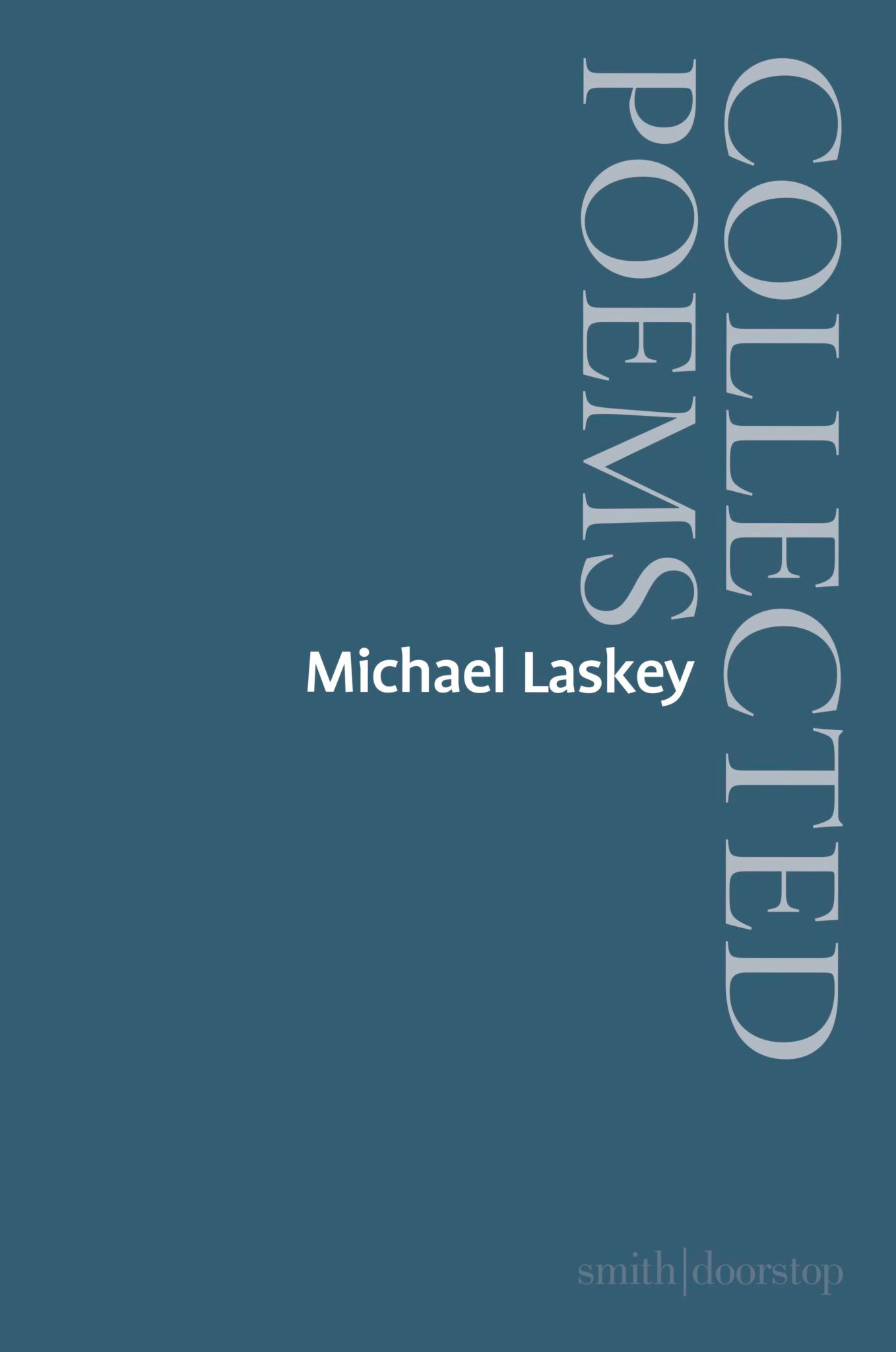
Three hundred and sixty-five poems, most of them under a page; you could read one a day for a year. In fact, even if you have the full set of Michael Laskey’s six collections, I’d recommend getting your hands on this Collected and doing just that. Apart from anything else, this nice fat volume includes a handful of new poems, and you wouldn’t want to miss them. I’ve read it from cover to cover over the past few weeks and have now gone back to read more slowly from the beginning. Why? Because I enjoyed it. Because it touched me. Because it made me chuckle. Because it made me feel happier about being in the world despite the way the world is. Reading Michael Laskey, I’ve decided, improves my mental health.
It’s something to do with his relaxed focus on what is easily overlooked. These poems make me more mindful, more attuned to things around me. Kitchen knives and chopping boards acquire significance. I see the more bizarre possibilities of clothes pegs. I notice the “useless rose windows” hidden inside cucumbers. How much I routinely miss of what’s right here in front of my eyes!
Reading Michael Laskey, I’ve decided, improves my mental health
It’s also to do with Laskey’s companionable modesty, his courteous restraint. He never says too much or talks too loudly. He takes pains to make his readers feel at ease. Having said that, some poems are not as seemly as they might seem. Take ‘Cloves of Garlic’ for example – I’ll never look at one in quite the same way again! Like another of my favourite poets, Kit Wright, Laskey makes light of his learning and his technical skill and often combines mischievous humour and self-deprecation with more serious thought.
Laskey’s boarding school education may have advantaged him in some ways, but not, one suspects, without emotional cost. The poem ‘Simpson and Newell’ captures perfectly the stomach-churning anxiety and dejectedness felt by a group of adolescents when faced with a rugby fixture against a much stronger team. The players run the gauntlet of “cocksure staring boys” and make their way to the changing rooms where half the pegs have been “decapitated”. Once there:
[…] Left to ourselves
we unzipped a little flamboyant
foul language and let it drop
into shallow pooled laughter; we bolted
the bog doors and sat briefly, slumped.[…]
And afterwards, quiet on the coach
returning to school through the settled
ache of that bruise-darkened landscape,
we breathed on the window and printed
our names in the mist back to front.
There’s that sense of the loneliness one can feel, even in a group. On a related theme, ‘Old School Tie’ describes Laskey’s meeting as an adult with a fellow pupil he doesn’t remember who turns out to have harboured a grudge against him for years and who relates, with gleeful vengeance, how:
on a Sunday evening last September
chugging home into the cut
against an offshore wind and looming
banks of mud and cumulonimbus,
he passed me crouching in the stern
of the Enterprise as it drifted backwards,
yanking madly away at the outboard
that wouldn’t catch. Made his day.
Typically, the poet allows himself to be the butt of the anecdote.
Laskey’s good with verbs, and they do lots of work in each of the poems above – “unzipped”, “crouching”, “yanking”. It’s interesting too, I think, that thundery clouds loom over both. Laskey’s poems usually enjoy good weather, but darkness is almost always part of the mix. Woven into poems about cricket, bicycles, babies, birds, happy families and firelighters, marmalade and soup-making, ratatouille and rice pudding, we find the deeper stuff of life that often goes unsaid. The poet nudges us gently, reminding us of our common emotional subtleties and contradictions, our guilts and resentments, fears and insecurities, joys and longings. He embraces it all, as in the poem ‘Curtains’ where, as with so many Laskey poems, the one-word title comes loaded with associations. The curtains in question (red velvet and threadbare) have been passed on through generations. He describes drawing them, “arms wide as if blessing the outside” and ends:
don’t leave that gap at the top.
Worn, but so what? They’re part
of the one flesh we’ve become.
Let them hang on here and declare
another day open, then put it
behind them, bring the evening on.
This awareness of life’s brevity and fragility is an idea he returns to frequently, finding always the perfect image or moment and catching it precisely. ‘A Tray of Eggs’, for example, describes a necessarily careful bike-ride (with a two-year-old on the crossbar):
[…] the eggs we bring home
in boxes and softly transpose
into the bevelled holes
in the cardboard tray, the domes
of these thirty shells
that will break like the days to come.
It’s often at the end of a Laskey poem that the depth of meaning reveals itself, but one has the feeling that he has arrived at the moment with you. It rarely seems a set-up job.
I’ve been wondering if it helps to be old(ish) when reading Laskey. Maybe. I’m not sure. His language doesn’t sound dated to my ear; it just seems conversational, comfortable and at ease with itself. However, being old(ish) myself, I delighted in words such as “palaver”, “kerfuffle”, “rigmarole” and “skedaddle”, and in references to tinned cling peaches and “top of the milk”.
Some poems are not as seemly as they might seem. Take ‘Cloves of Garlic’ for example – I’ll never look at one in quite the same way again!
One of the joys of reading Laskey is his fascination with words and the “crinkle of pleasure” he gets from savouring them. Several years ago, I was lucky enough to attend an Arvon course led by him and Helena Nelson. The first exercise he set us was to write a poem about a word. The stimulus he offered us was ‘Bodkin’ by Vona Groarke. He could equally well have shared one of his own ‘word’ poems – ‘Hassocks’ or ‘Bayonet’ for example, or the truly hilarious ‘Callipygian’ – but no, he drew in the work of another poet, as he did throughout the week, clearly relishing the pleasure of promoting and discussing poems he admired.
But when it comes to his own poems, the ones that touch me most are about his children. I love ‘Registers’, which is about the day his son Jack started school:
Out of the warm, primordial cave
of our conversations, Jack’s gone.
No more chit-chat under the blankets
pegged over chairs and nipped in drawers.[…]
Good boy, diminishing down the long
corridors into the huge unknown
assembly hall, each word strange,
even his name on Miss Cracknell’s tongue.
I remember asking Michael Laskey about Miss Cracknell. “Did you make up the teacher’s name?” I asked. “No,” he said, “it was her real name and suited the poem perfectly.” Of course. It had to be. The poem rings true … because it is.
There’s wisdom in Laskey’s poetry, but the touch is so light and deft, it’s easy to miss
This collected volume, a whole lifetime of poetry, allows you to settle down and immerse yourself in Michael Laskey’s world, which always feels to me like a good place to be. The poems are arranged skilfully, in such a way that they speak to and affirm each other, and the effect is cumulative. There’s wisdom here, but the touch is so light and deft, it’s easy to miss. You aren’t struck by his ‘style’, for the simple reason that he doesn’t put a foot wrong – nothing jars. The poem ‘Signature’ is ostensibly about a lizard, but Laskey could well be describing his own unassuming poetic trademark:
a rustle in the gorse
stops me short:
dashing off
its signature
in invisible ink,
a lizard
I’ve blinked
and missed.
Annie Fisher’s background is in primary education, initially as a teacher and later as an English adviser. Now semi-retired she writes poetry for both adults and children and sometimes works as a storyteller in schools. She has had two pamphlets published with HappenStance Press: Infinite in all Perfections (2016) and The Deal (2020), and one recently from Mariscat Press: Missing the Man Next Door (2024). She is a member of Fire River Poets, Taunton.
As well as browsing our Substack, it’s worth visiting The Friday Poem website where you can browse our Archive of more than 700 posts dating back to early 2021.
Help support The Friday Poem – buy us a coffee to help us stay awake as we strive to bring poetic excellence to your inbox every Friday. If you can’t afford to donate, no worries, we’re going to keep on doing it anyway! Big thanks for everything, you lovely poetry peeps.
I wasn't familiar with this work, but you've made it very tempting. Thank you.
A wonderful introduction, thank you, this is certainly on my wish list now