


Outside
Some days I’m the oak, those years
of learning written in rings
inside me. At other times
I’m the concrete weir, whose sharp
and shaming edge interrupts
the water’s flow. If I step
outside myself, I see both
oak and weir, how suffering
shapes their being. It’s then that
compassion grows. The stream feeds
the oak, softens the weir’s edge,
and knows no words, nor needs them.
‘Outside’ is from Still by Alan Buckley (Blue Diode Press, 2025) — big thanks to Rob Mackenzie at Blue Diode, and Alan Buckley, for letting us reproduce it here.
Alan Buckley’s new collection is self-consciously self-conscious. But in a good way. In fact, there’s even a nine-page ‘Note on the Form and the Place’ at the end of the book, where the poet outlines how the collection developed in thematic and technical terms, explaining elements of his method.
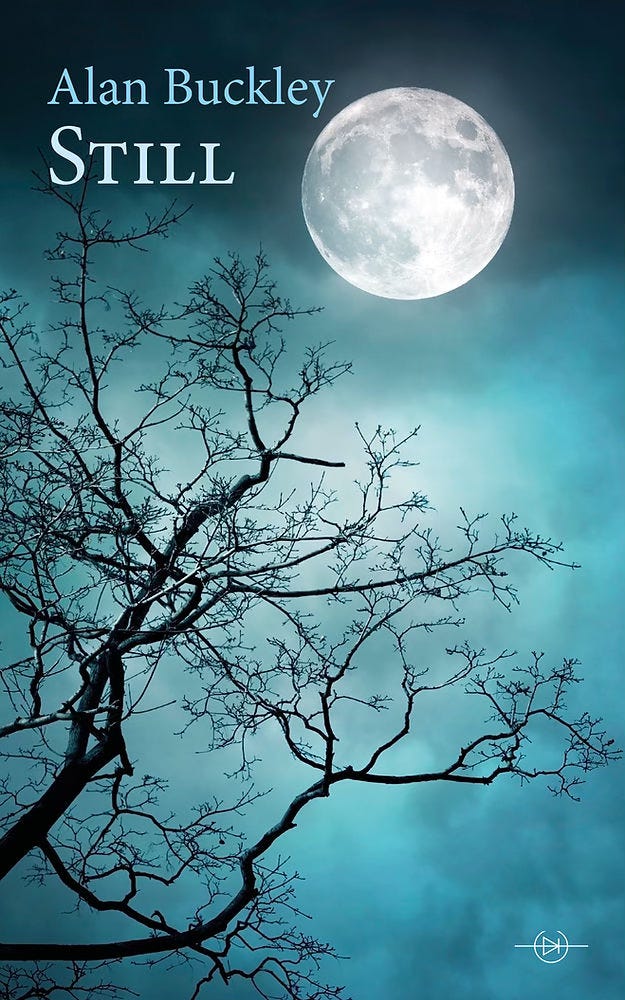
Buckley is hugely aware. Of the self. Of the natural and social world around the self. Of the relationship between them. Of the uses of language in poetry, starting with this collection’s title. The word ‘still’ appears nine times throughout the book, used in different ways and in different contexts, underlining the multiplicity of its semantic and syntactic roles.
However, there’s another word that’s repeated far more frequently. ‘But’ (or its variant, ‘yet‘) crops up no fewer than twenty-two times. Often its role is pivotal, acting as a hinge where a poem opens into its core, or is balancing two perspectives, or at a point of movement between the natural world and human feeling. Here are a couple of instances:
[…] The air’s begun
to cool down. But in my back
the fox’s eyes keep burning.
(from ‘Fox’)
I know you’re hurting. Being
here feels too much. But would youchoose to leave a place that can
offer you moments like this?
(from ‘Seesaw’)
In metrical terms, this last extract also feels especially interesting as an example of the poet’s technique. Let’s look at why.
These twelve-line poems are in syllabics. However, Buckley’s clearly aware that the coherent and cogent use of such a form in English cannot ignore the natural stresses running through each line, the iambs and trochees, the anapests and dactyls – all surging and ebbing within a syllabic framework that offers a quieter music just below those stresses.
Alan Buckley’s new collection is self-consciously self-conscious. But in a good way
As the poet explains in his notes, he’s decided to write in heptasyllabic lines. Given the predominance of iambs and trochees in English-language poetry, this is an unusual choice, not least because syllabics naturally lend themselves to even-numbered lines. So why seven syllables? Well, as Buckley states himself:
I like the unexpected rhythms the seven-syllable line throws up, always hovering between three and four stresses without ever settling on either. And I like the way it creates an intense focus on line breaks and word choice […].
Going back to the closing couplets of ‘Seesaw‘ (quoted above), it’s possible to see this technique in action. Every line seems to hold back the natural final word or syllable, then deliver it as the opening word to the following line.
Every line seems to hold back the natural final word or syllable, then deliver it as the opening word to the following line
If Buckley has a focus on generating pivots and hinges within each poem, as discussed earlier, so the stresses and syllables of each line offer a microcosm of that same device, demonstrating the unity of his approach, always striking a balance, always seeking out counterpoints. Moreover, that unity is present in other ways through the book, from the word ‘Balance‘ being invoked as the title for one of the individual poems, to the use of ‘Here (I)‘, ‘There’, and ‘Here (II)‘ as titles for the collection’s sections.
The poems in Still are rooted in a place and in the daily experience of walking through that place. Nevertheless, that doesn’t mean that they turn their back on the explicit exploration of concepts or ideas. In fact, the opposite is true, as in ‘Muntjac’, reproduced here in full:
Months back I’d startled one off
the path, the fear in its blankgaze a mirror of my own.
Now, walking up from the brook,I glance ahead at the gap
in the spinney, see a strangeanimal in silhouette,
with four wings raised on its back.A small reminder – thank you –
that fear can be close to joy.The deer bolts, hurling the pair
of magpies into the air.
Few contemporary UK poets are as comfortable as Buckley in their invocation of abstract nouns. In this case, as in many others, he brackets them with real and/or surreal concrete experiences, yoking them to a specific context of layered nuances.
In his approach to prosody, in his use of language, and in the way he delves into life, Buckley continually demonstrates a fierce ambition, the poet refusing to take the easy way out of the poem’s emotional truth. He might easily be labelled a poet’s poet for the way he implicitly encourages other writers to revisit their own methods, but his poetry is also accessible, working through universal ideas via apparently simple language. Still will appeal to a broad church, but should also find a particular niche among poetry aficionados. It deserves both.
Matthew Stewart works in the Spanish wine trade and lives between Extremadura and West Sussex. Following two pamphlets with HappenStancePress, his first full collection, The Knives of Villalejo, was published in 2017, and his second collection, Whatever You Do, Just Don’t, in 2023. Recent poems have featured in The Spectator, The New European and Wild Court. He blogs at Rogue Strands.
As well as browsing our Substack, it’s worth visiting The Friday Poem website where you can browse our Archive of more than 700 posts dating back to early 2021.
Help support The Friday Poem – buy us a coffee to help us stay awake as we strive to bring poetic excellence to your inbox every Friday. If you can’t afford to donate, no worries, we’re going to keep on doing it anyway! Big thanks for everything, you lovely poetry peeps.
Lovely
I love the focus on technics in this review, it's so sensitive to detail.