


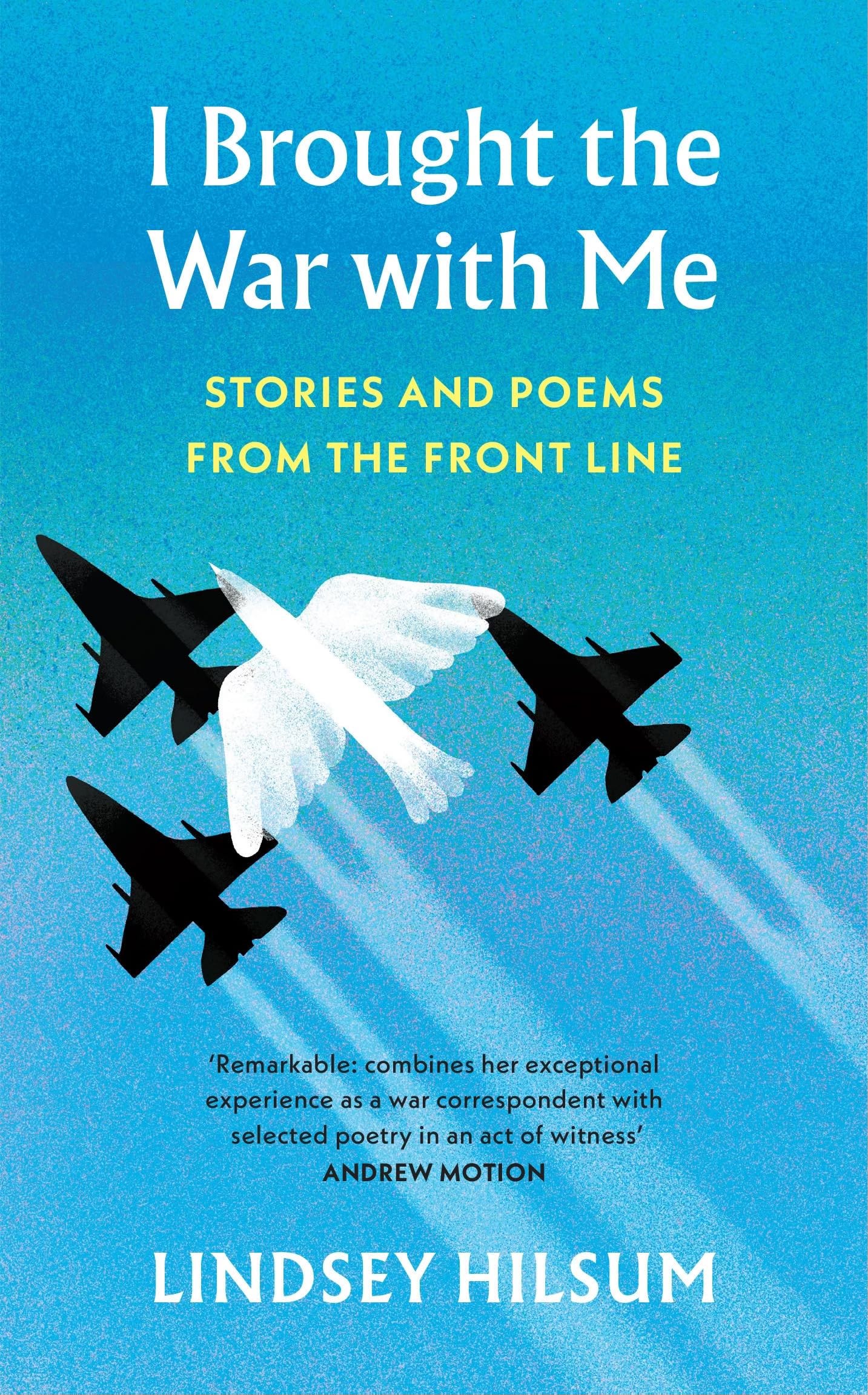
I started writing this review after going to see Lindsey Hilsum speak at the Parisot literary festival in France in mid-October last year. At the time, all minds were on the Ukraine War. Then life got in the way of writing, in various ways. I return to it now, with yet another, different war in the headlines, this time in Iran.
War. Lindsey Hilsum’s subject. Poetry’s subject. Everybody’s subject.
Parisot is a small village in the Quercy-Rouergue region, at the crossroads of Tarn-et-Garonne, Lot and Aveyron. Every year since 2013 a dozen or so French- and English-speaking writers come to talk about their latest books. It’s free, and there’s tea and home-made cake on offer (though their sound guy could do with some training). A mix of English, French, and other Europeans come from near and (occasionally) far to participate. On this particular warm and sunny afternoon about a hundred of us crowded into a large airy room, keen to hear some poetry and listen to Lindsey Hilsum’s stories about life as a war correspondent.
Lindsey Hilsum — well, you’ve probably seen her on the telly. She’s the International Editor for Channel 4 News and has covered conflicts and refugee movements all over the world, including Afghanistan, Syria, Iraq and Kosovo. In 1994, she was the only English-speaking foreign journalist in Rwanda when the genocide started. In 2021, she was in Kramatorsk in eastern Ukraine when she was woken by loud explosions – Russian artillery attacks on military targets around the town signalling the beginning of the Russia-Ukraine War. She was a close friend of Marie Colvin, the Sunday Times correspondent killed in Syria in 2012, and wrote about her life – In Extremis: The Life of War Correspondent Marie Colvin. So she knows a bit about war.
She knows a bit about poetry, too. In nearly four decades of war coverage she has always carried a book of poetry with her. While covering the war in Ukraine she started tweeting a poem a day. People began to engage with her online, share the poems, and ask for more. So she wrote this book. In further explanation, she writes:
In September 2022, a few days after Russian forces retreated from the Ukrainian town of Ilium, I was standing outside an apartment block that had been split apart by a missile. Fifty-four residents had been killed in the Russian attack, which had taken place six months earlier. Purple and yellow wild flowers were growing in the rubble that filled the chasm between the two parts of the block.
‘It’s not the houses. It’s the space between the houses,’ I thought. ‘It’s not the streets that exist. It’s the streets that no longer exist.’ The words of James Fenton’s 1981 poem ‘A German Requiem’, about selective memory in the Second World War, came to me when I could no longer find my own.
Back at my hotel in Kharkiv, I looked it up.
It is not your memories which haunt you.
It is not what you have written down.
It is what you have forgotten, what you must forget.
What you must go on forgetting all your life.The idea that the spaces between the houses symbolised gaps in memory, and that forgetting might be essential if people were to live together in peace, encapsulated the future facing the Ukrainians I had met that day. […] My TV news report reflected some of this, but it did not have the allusive power of the poem.”
She’s clear about the limitations of journalism and news reporting:
“While the images we show have great impact, I feel that journalistic language sometimes fails to convey the intensity of the experience. Maybe James Fenton’s poetry resonates with me because he was a war correspondent as well as a poet – he sees what I see but has found a more compelling way of expressing it, as if he is working in three dimensions while I am stuck in two.”
Her aim, in this book, then, is to “marry reporting with poetry,” the ‘telling it straight’ with the ‘telling it slant’. Each one of fifty stories from conflicts she has covered, between 1986 and 2024, is twinned with a poem that sheds light on it, one way or another. The title is from ‘War Poem’ by Warsan Shire:
What do I do? I think I brought the war with me
unknowingly, perhaps on my skin, plumes
of it in my hair, under my nails.
Hilsum twins Shire’s poem with a story about her own experiences in Kabul, Afghanistan, where she first met Farzana Kochi, a 26-year-old member of the Afghan parliament. Under Taliban rule, Kochi’s life became increasingly difficult. From 2021, when the Taliban retook Afghanistan, Afghan women and girls were gradually deprived of their freedom of movement, the right to control their bodies, and the right to education. Resistance to the Taliban was brutally suppressed. Kochi received death threats. Her office was raided. Eventually, she fled Afghanistan, disguised in a black niqab, for asylum in Norway. Hilsum writes, “Like all stories, Farina’s is unique, but it is recognisable to thousands of other women forced into exile. Warsan Shire writes of a refugee who also feels responsible for her mother, and who cannot shake off the nightmares or rid herself of the stench of war.”
The poems Hilsum quotes are from a variety of writers, including soldier-poet Siegfried Sassoon, thirteen-year-old Amineh Abou Kerech who fled Syria with her family at the age of eight, Kevin Powers, an American soldier who fought in the Iraq war in 2004/5, and Xi Chuan, one of China’s most celebrated contemporary poets, essayists and literary translators. Hilsum includes an extract from ‘The Exaltation of Inana’ by Enheduana, a Babylonian high priestess and princess from Ur (in what is now Iraq) and the earliest author whose name has been passed down in history. There’s an extract from Paradise Regained from John Milton. And there are poems from Christina Rosetti and Shelley, two from A.E. Housman, and one from Stephen Crane (also a war correspondent). The rest are from twentieth-century poets, including old favourites Anna Akhmatova, Bertolt Brecht, W.H. Auden and Eavan Boland, and younger poets such as Mosab Abu Toha, a Palestinian writer, scholar and librarian from the Gaza Strip, and Halyna Kruk, a Ukrainian poet and Professor of Medieval Literature at the University of Lviv.
One poem I found particularly moving is ‘Now the City has Fallen’ written by Andrew Waterhouse in 2000:
Women are shackled and painted red
the men given false beards and new names;
I am He Who Looks Nervously Behind,
my friend is He Who Looks Nervously Above.
They want us all to be very nervous.
Hilsum links this with a story about her time in al-Hol camp in Syria, where Kurdish fighters held some of the 70,000 women they had captured while trying to liberate Syria from the Islamic State Caliphate. The women didn’t feel liberated; many remained fanatical supporters of IS. One woman, Yasmina, aged nineteen, had been married six times to six different fighters. Each time a husband was ‘martyred’ – killed in battle – she was passed on to another one. Hilsum asks her, “How do you feel about that?” She replies, “It was fine because I was following the word of the Prophet. […] All of this is for the glory of God.” Yasmina had gynaecological problems and couldn’t have children. For this, she blamed the Americans.
Yasmina may have been a prisoner of the Kurds, says Hilsum, but her real gaolers were the jihadis who had captured her mind and destroyed her body, as Waterhouse’s poem makes clear:
Our children are taken from us and reared
in darkness. It is unclean to wash the body,
only the soul can be touched and scoured bright.
It must be left out on the roof tops for the sun and moon.
This is the law.
Hilsum says, “Some women in al-Hol had absorbed the jihadi vision, but others just kept their heads down, trying to survive the imposition of a brutal, alien ideology, looking nervously behind and above.”
Another key poem is Wislawa Szymborska’s ‘The End and the Beginning’, written in 1993 to warn against the seemingly inevitable forgetting of the true horrors of war:
After every war
someone has to clean up.[…]
Someone, broom in hand,
still recalls the way it was.
Someone else listens
and nods with unsevered head.
But already there are those nearly
starting to mill about
who will find it dull.
Hilsum pairs this poem with details of the hearings of the International Criminal Tribunal for Rwanda (ICTR) in Arusha, Tanzania, where Jean-Paul Akayesu, and others, stood charged with genocide and crimes against humanity for their actions in Rwanda. Hilsum herself testified at the hearings. She calls the Rwandan genocide, where more than half a million members of the Tutsi ethnic group were systematically killed by Hutu militia, one of the most brutal mass crimes of the twentieth century. By testifying, she says she was trying to put history to rest, hoping that the testimony of those who had seen with their own eyes would count for something in the battle between remembering and forgetting.
… fifty different stories from all round the globe can start to feel like atrocity heaped upon atrocity, and one can be overwhelmed by it
So, what about Hilsum’s aim – to “marry reporting with poetry,” the ‘telling it straight’ with the ‘telling it slant’. Does this work? Yes, well enough. Certainly, each vignette is a fascinating glimpse into the horror of war. She writes well and empathically, and the poems are carefully chosen; they often flesh out or offer a different perspective to her experiences. I was pleased to discover new voices in poetry from all around the globe.
But fifty different stories of war can start to feel like atrocity heaped upon atrocity, and one can be overwhelmed by it. Also, at times I yearned for a longer, more in-depth treatment of the people and places Hilsum had visited, rather than just a couple of pages with a brief character sketch. I recently read War by American journalist Sebastian Junger about his time embedded with second platoon of Battle Company in the Korengal Valley, a transit corridor for Taliban fighters coming into Afghanistan from Pakistan. It’s shocking, and compelling, and by the end you feel you know the soldiers Junger was living alongside, intimately. To me, the deep dive feels more satisfying than the whirlwind tour. Maybe Hilsum’s book should be served in small portions.
Hilary Menos is editor of The Friday Poem.
Vital Statistics: The Friday Poem has more than 3600 subscribers with 27,000 views in the last 30 days. It’s run by four people – Hilary Menos (Editor), Helena Nelson (Consulting Editor), Bruno Cooke (Spoken Word Editor) and Andy Brodie (Web Editor), with contributions from a team of reviewers and writers.
Until recently we maintained the Friday Poem website (thefridaypoemdotcom) as an archive of 700 posts published between 2021 and 2024 (including most of the original Friday poems) but following a catastrophic hack we have made the difficult decision to take this down. We’ll be republishing some of these posts here on Substack in the future.
Help support The Friday Poem
Buy us a coffee to help us stay awake as we strive to bring poetic excellence to your inbox every Friday. Heartfelt thanks to everyone who donates, especially to our regular donors. If you can’t afford it, no worries, we’re going to keep on doing it anyway! Big thanks for everything, you lovely poetry peeps.
Fascinating review and what you say about covering so many wars over against diving deep really resonated.
And so sorry to hear about your website.
i always enjoy reading your comments and wonder if poetry of war softens the horror of war - makes it more human in its approach? it sounds bizarre but poetry has got a human approach to the reality of war.