


Poem for John Clinging
Of you, John, there was nothing to go on –

nothing but your smithereen of skin and bone and plane.
You were one of the quick and the dead

and far too many of them to crowd into the dining-room.
You came alone, the chosen one
miscarried, made, laid out among them –

Gran, my mother and, in the blustering silence, Brodie Anderson.
And then you were no more alone, old navigator, party to

their incompletion.
So it was that when at last my mother helped me lay her down

I took you into my own heart’s pondering
and still she claimed and wouldn’t dream of claiming you her one and

only. ‘You’d have liked him,’ she said to me
often. I think I would have done.
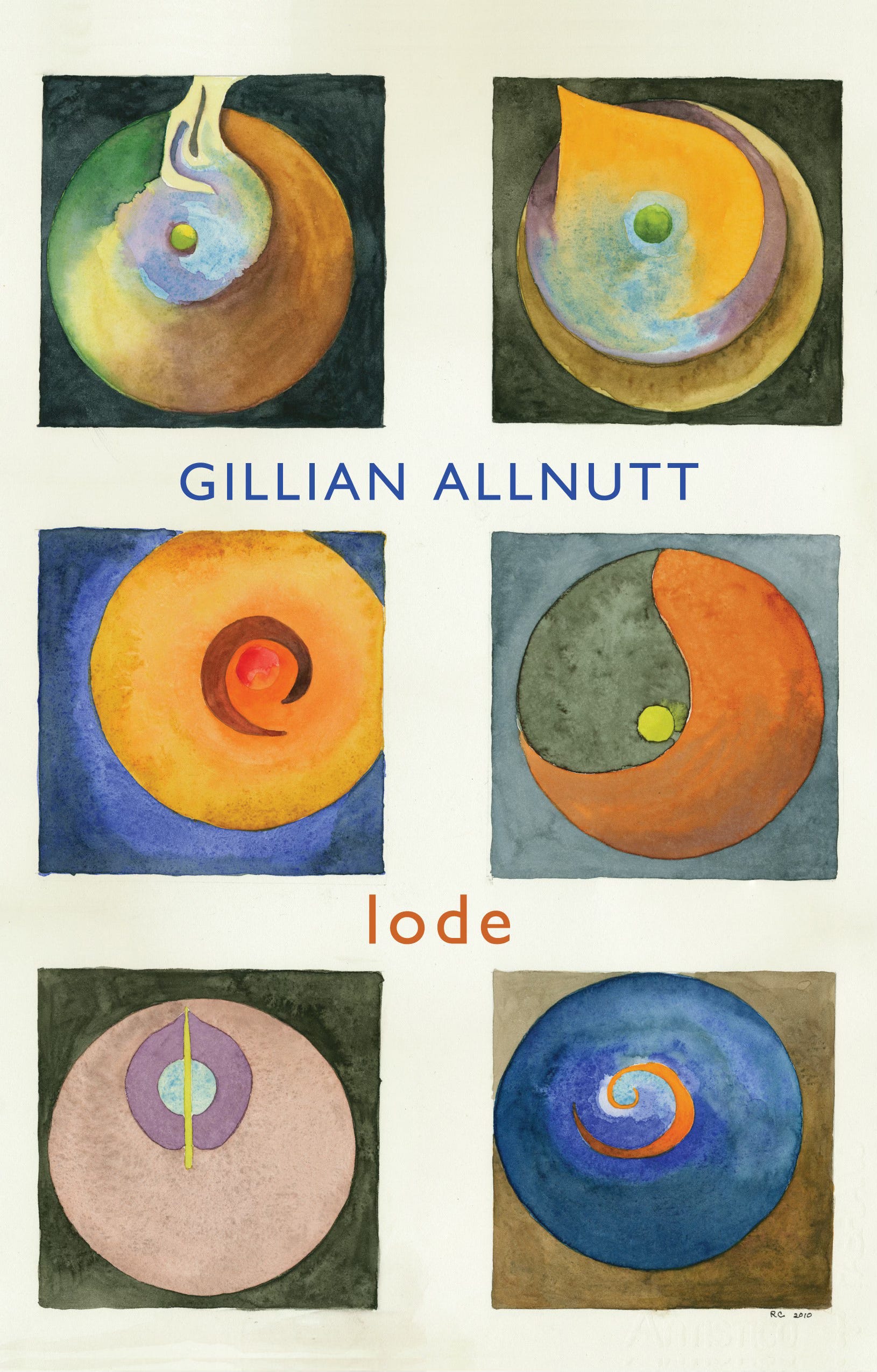
(POEM) is from lode by Gillian Allnutt (Bloodaxe Books, 2025) — big thanks to Bloodaxe for letting us reproduce it here.
I’m often overwhelmed by the verbosity of contemporary poetry. Gillian Allnutt is the antidote. Here’s one of hers from wake (2018):
considering
the dear improbability of cricket on the radioof you.
Ten words. One iambic line of sixteen syllables followed by another of only two. Simple, personal, heartfelt. No finite verb, so no time frame, no action completed. Just a cargo of feeling travelling towards ‘you’. Each line unit has its own particular, and particularly pleasing, rhythm. The emotional payload hinges on the gentle wittiness of “dear”.
The winning poems in this year’s National Poetry Competion averaged 399 words in length. So Gillian Allnutt isn’t typical of the age. Nor is she young. Still, she’s very much alive. Her 2025 collection, lode, was short-listed for the Eliot, her third appearance on that list. Oh, and the average poem-length in lode is 82 words. Those who praise Allnutt praise her highly. The rest may be forgiven for sometimes being nonplussed by her ways with and around words. Her spareness is striking; it can be hard to know how to approach her.
I first encountered this poet in 2007, the year of How the Bicycle Shone (New & Selected Poems). The Selected opens in the 1980s, when Allnutt favoured single-space text (though her default length was always modest). Back then, you could see her stanzaic shapes at a glance. By Wolf Light (2007), however, a preference for wider spacing characterised more than half the poems. Some (‘Magdalen, ‘Love’, ‘Tabitha’) have huge spaces between lines. ‘Tabitha’, for example, begins:
In my sark lain.
Let me now go to the field and glean
Peter came.I have mixed feelings about such spacing. To me, it can undermine aural connections, and make individual lines seem too momentous. I’ll come back to this later. And yes, the allusions are biblical, and yes, this is a poet immersed in the Christian tradition. You can’t go to a Catholic convent school and not be. But this frame of reference enriches her enquiry, which is spiritual, not evangelical.
I’m often overwhelmed by the verbosity of contemporary poetry. Gillian Allnutt is the antidote
All the same, it helps to know the biblical tales: Ruth in the alien corn, Mary Magdalen oiling Christ’s feet, Tabitha being raised from the dead by Peter. Because this poet comes back to the same stories many times. Her poems (and collections) are inter-connected to an extent I’ve not seen in any other poet, and not just in content. In the quotation from ‘Tabitha’ above, there’s a musical feature that links lines, texts and whole books. The last word in every line rings out with more than mere rhyme. The N-consonant at the end of “lain”, for example, strikes a note as clear as a gong at the start of meditation. “Lain” calls to “glean” (Ruth in the cornfield). “Field” and “glean” cradle the long E of “Peter”, before “came” switches back to the long A of “lain” . This is Allnutt music. There are such transitions in most of her work, as well as key words and key consonants – N, M, L, R and T in particular. Somewhere in every collection, and usually in several places, the plangent N in “stone” will call to its familiars. There are many of them (bone, alone, own, thorn, again, rain, gone, moon, and others). Equally, the soft L in world or soul may invoke bowl, still, all, small, well, whole or April. The R in “war” calls to … but I’m getting ahead of myself.
Here’s a poem from lode, the book I set out to review before I disappeared into earlier volumes. There are as many words in the title as the text:
‘Wouldst thou witten thy Lord’s meaning in this thing?’
Unself-aware, un-witting as the flower of winter
jasmine, listen −
That’s it. The whole poem. Some might be non-plussed by its brevity, or uneasy about “Lord” in the title. But the key’s in the final word. Listen and the meaning will come through. W drives the alliteration but N calls from the stressed syllable at the beginning and end of line one (“un”). This is intensified by breaking on a hyphen (something the poet rarely does). N sings on through “witting” and “winter” and “jasmine” (where M adds warmth). The cadence resolves with “listen”, an imperative in which S adds its gentle sibilance to the idea of sound. Meanwhile the ‘air’ sound in “aware” is whispering to ‘er’ in “flower” and “winter”. Every line has its own rhythm, although each runs into the next syntactically.
This cryptic little number also has discoverable meaning. The title quotation is from Julian of Norwich (one of many references to her in Allnutt books). The medieval anchoress was trying to understand her visions when she posed the question. But that was then; this is now. What’s the meaning of this thing? Or any poem-thing? The poem is the answer. If you want to understand the communication, put your ‘self’ to one side, settle for not knowing, and just … listen. This is an ars poetica. The idea of listening is central to Allnutt’s practice, and it’s what reading her work requires. Otherwise, you won’t pick up the extraordinary intricacy of her sound structures. So what about the wide-spacing? Well, for a poem so short, it doesn’t matter. You can see the shape of the whole at a glance. You can read it backwards, forwards and sideways as many times as you need − while listening.
In some poems in lode, however, widely-spaced text seems to me more problematic. In ‘a place beyond belief’, for example, the spacious format makes it hard to see that the text is structured in three quatrains, each ending on a dash. Dramatically different line lengths exacerbate the issue. The second stanza opens with a line so long that its final word has to drop onto the line below. This makes the ensuing short line look like a new stanza, viz:
          rubbing the shine once more into the grain of table and sideboard
								                                                    drawer
as if out of thin air
knowing all shall be mended or amended here
and she beyond fear –
There are more interesting issues than spacing, but I wonder whether the eye can grow used to a norm that isn’t always in the interests of the poem. The individual line is vital, but surely stanza units are important too? These days wide-spaced formats are increasingly common, and ordinary leading is more generous than of old. Still, when I hear Allnutt read aloud, her vocal pauses don’t seem to me as long as her formatting looks. The Eliot recording of ‘Poem for John Clinging’ illustrates this. This poem has eight stanzas, mostly two-liners, though at first you may not see that. The third stanza is one line alone. Yet in her reading, the poet run the enjambment from stanza three to four with only a fractional pause (“You came alone, the chosen one // miscarried, made, laid out among them”).
Apart from my spacing reservations, Poem for John Clinging is a fascinating poem. An endnote tells us that the dedicatee was a maternal uncle, an RAF navigator in the Second World War, blown up in mid-air with the rest of his crew. Those familiar with earlier work may recall him from ‘Poppa’ in Sojourner (2004) and ‘Near the Peace Garden’ in wake (2018). In some other collections, the word “war” is also key (it appears eight times in Sojourner). But here in lode, in the opening section (‘Postwar’), it’s everywhere. And not just as a single word – whole phrases: “before the war”, “after the war” “during the war” (in each, an R sounds twice).
In reflecting on such repetitions, I realised why the ‘Postwar’ section of the book was affecting me so strongly. Allnutt was born in 1949, just after the Second World War; I am only four years behind her. Without knowing it, we post-war children absorbed the phrases that floated past us while adults talked − “before the war”, “during the war”, “after the war”. We were always hearing that. The sound was cemented into our brains. In two poems (‘refugee born London 1949’, and ‘Dunstanburgh’) the R of “war” growls through numerous words (“more”, “are” , “here”, “tower”, “far”, “story”, “parents”, “sorrow”, “endure”, “dour”, “before”, “where” etc). How can lived experience be communicated through sound alone? I don’t know. But it seems it can. This work is all about listening – and that includes listening to messages from the dead.
How can lived experience be communicated through sound alone? I don’t know. But it seems it can
Three decades earlier in ‘Bone Note’ (Blackthorn 1994), Allnutt referred to the musical side of being a poet. She referred to “what, beyond the word, / begins in me and is bone-heard”. In a T.S. Eliot Youtube clip this year (2026), she talks about being “fed up with words because of the precise content that they carry and have to carry [ … ]. I have been, I hope, travelling from being head-based to heart-based, and music speaks of and to the heart.” But there’s plenty of evidence that she has always been attracted to heart-based elements in poetry, by which I mean intuitive aural connections between word-sounds, rhythm and meaning. She hearkens to specific patterns, involves them continuously, works via practised intuition.
In the five lines of ‘summertime’, one of my favourites in lode, there’s movement from M (in the title and first three words) towards the N in “rain” and thereafter all other line-end sounds. It’s both plangent and loving, a poem about absence. Again, the emotive charge depends on “dear” in the last line:
mute or musical as morning rain
and you as always gone
how I listen to your absence to my own
to the now and then of wood pigeon
its dear inconsequential circumlocution
A reader might note this as a rhyming piece – but it’s not metrically regular. (Allnutt doesn’t do metrical stanzas.) All the same ‘Summertime’ starts almost like a formal lyric, nearly iambic pentameter (slip in an extra ‘as’ before “mute” and you’re there). The second line, too, could be three iambs. But line three is different: it runs in little spurts – “how I listen” … “to your absence” ... “to my own”. In line four, “to the now and then” swings by slowly and spaciously, and so does “of wood pigeon”. As for the concluding line – what an astonishing performance! By all rights, it ought to be clumsy with those five-syllable giants, but it trips past like a dancer, the syllabic stress of “circumlocution” mirroring “inconsequential”. Surely this is a contender for a ‘neon line’ nomination in Ian MacMillan’s The Verb?
Having said which, there are many ‘neon lines’ in Allnutt. Often a stand-out phrase depends on an unexpected adjective/noun conjunction followed by possessive attribution. For example in lode’s ‘for only then can’, there’s “the common-law procedure of a poem”. Simple but elegant. In ‘Corbridge’, who could resist “involved in the recitation of the rain”? Sometimes the magical phrase splits across a line, as in “the long-shared anonymity / of day” (‘Pink Jenkins’). Such patterns have been popping up for decades. In Blackthorn (1994), there were “the unprepared cathedrals of my heart”. In Nantucket and the Angel (1997): “There is the special anonymity of rain”. In Lintel (2001):“Think of the unexpected helpfulness of water.” In Wolf Light (2007) – perhaps my favourite – “we listen to the worn asseverations of the wind”.
But back to ‘summertime’ in lode where so many sounds lead securely to its neon line. The dominant N is invoked by the teleutons (“rain”, “gone”, “own”, “pigeon”, “circumlocution”). “Rain”, “gone” and “own” are old favourites (“own” appears twenty times in lode). Might someone suggest that Gillian Allnutt is an unimaginative poet who keeps using the same rhymes? If so, they would be missing the point. It’s not about rhyme. It’s about the way certain resonant sounds invoke a mental (even spiritual) demesne.
Not every poem in lode fits this sort of reading. ‘Flame-thrower’ is a sestina, and as such depends on multiple repetitions. And yet none of its line-end words are old friends, and neither consonance nor assonance strike me as attractive as usual. The piece is single-spaced, with the sestets easily visible, but I’d say ‘Flame-Thrower’ is head-based rather than heart-based, its music less bone-deep than most. It links to familiar content – the poet’s father’s memory of the burning of Crystal Palace, his later war-time experience in a flame-throwing tank regiment − but does it work as a whole? Not entirely, I think. It’s complicated rather than complex. The finest Allnutt poems look simple.
… this poet can also be funny, even in a collection focussing on inherited war-time trauma and Covid lockdown
I’ll conclude by discussing the opening poem of lode, not least because it shows this poet can also be funny, even in a collection focussing on inherited war-time trauma and Covid lockdown. An endnote to ‘Audience’ reminds us that Gillian Allnutt was awarded the Queen’s Gold Medal in 2016, and went to Buckingham Palace to receive it. So ‘Audience’ refers to that meeting with the Queen, though poems have their audience too. This seven-line piece (an opening stanza of three short lines followed by a quatrain) turns on L sounds. You might say each line rhymes (or half-rhymes). I prefer to note the way a soft L dominates. It’s a gentle sound for a gentle piece. The word “queen” is also an old friend and appears often in her work, as does “moon”, though this is the first appearance of The Queen. “Soul” is another Allnutt word, often appearing near “whole”, or “hole”, as it does here. The brief opening stanza invokes the poet’s feelings – or the Queen’s feelings – or both:
Shyness, common and small,
a shrew, a plimsoll
and that’s all.
Shyness is common, and the poet is a commoner. A shrew is the shyest, tiniest of mammals. A plimsoll is the most un-royal of shoes. Perhaps that’s how it felt being in Buckingham Palace – small, unroyal. The repeated ‘sh’ sound suggests an awed hush. But don’t miss the ghost-rhyme joke (“shyness” rhymes with “Highness”). Then the tone changes with the second stanza:
The Queen, majestic, merciful,
the moon’s own soul. Poor soul
must have acquainted herself with every holt and bolt-hole
of it, every last hat (optional).
The Queen is compared to the moon in sixteenth-century mode, and the language is accordingly formal. But when “soul” is repeated, the thought and the register veer in a different direction. How often we say, compassionately, “poor soul” – though rarely of a queen. It seems that the “shyness” perhaps did belong to the monarch too, and also the smallness. Suddenly the Palace conceals many hiding-places, all of which the Queen as potential escapee must know. The long line scurries and hurries like the shrew making a dash for it. The T consonants stutter anxiously. Slipping “of it” over a line-end is surely mischievous. And where did “hat” come from? Well – there’s a rhyme connection to “that’s all” earlier, as well as a consonantal link to all the T sounds. The whole poem could easily have ended with “every last hat”, making it a final ta-dah! I hear it being said with a regional accent and I visualise the acres of stylish headgear that our late Queen certainly possessed.
But that phrase is not the end. There’s another word in brackets. At first reading, you wonder what “optional” is doing there. The sound just about fits the rhyme pattern, if not exactly gracefully – but why is the adjective appropriate? Think about it. A formal invitation to Buck House will include guidance on dress. It will not suggest wearing plimsolls. It will, however, say “hats optional”. When you speak the word “optional” aloud, you hear the “sh” inside it, harking back to “shyness” earlier. But the voice that says “optional” is not the voice that says “every last hat”. No, “optional” is the Queen’s voice inserting a correction, a point of order. This is a gently witty piece about a solemn occasion. There are innumerable places to hide in a palace, and thankfully not a few in a poem. Wouldst thou witten where they are? Gather thy wits. Listen.
Helena Nelson is Consulting Editor of The Friday Poem.
Vital Statistics: The Friday Poem is run by four people – Hilary Menos (Editor), Helena Nelson (Consulting Editor), Bruno Cooke (Spoken Word Editor) and Andy Brodie (Web Editor), with contributions from a team of reviewers and writers.
Until recently we maintained the Friday Poem website (thefridaypoemdotcom) as an archive of 700 posts published between 2021 and 2024 (including most of the original Friday poems) but following a catastrophic hack in late April we made the difficult decision to take this down. We’ll be republishing some of the poems, features and reviews on Substack in the future.
Help support The Friday Poem
Buy us a coffee to help us stay awake as we strive to bring poetic excellence to your inbox every Friday. Heartfelt thanks to everyone who donates, especially to our regular donors. If you can’t afford it, no worries, we’re going to keep on doing it anyway! Big thanks for everything, you lovely poetry peeps.
Tremendous review of a tremendous poet.
Very glad to read this excellent overview. I loved Lode.